THE THREE-LAYER AUDIT - A KODIAC FRAMEWORK

What AI says. What AI sees. What AI is told.

The three-layer audit is the diagnostic framework Kodiac built the platform around. Most AI visibility tools scan a single layer - usually AI output - and tell you to write more content. The three-layer audit scans output, input, and ecosystem so you can see the actual root cause of your AI visibility.

Run free three-layer audit → See Kodiac Audit
THE FRAMEWORK

Three layers. One complete picture.

Each layer answers a different question. Each layer has its own metrics, sources, and interventions. None of them work in isolation. The three together form the only complete diagnostic for AI-mediated brand discovery.

Layer 01 - Output

What AI says about your brand

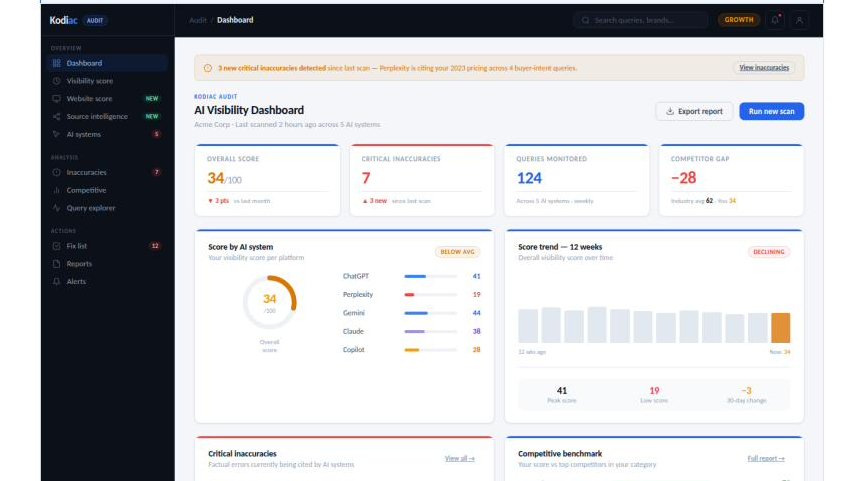
How ChatGPT, Perplexity, Gemini, Claude and Copilot describe you right now. Visibility scored 0–100 per system. Inaccuracies flagged. Competitive share of voice tracked weekly.

+
Layer 02 - Input

What AI sees on your website

Per-page AI-readiness scored across 10 dimensions. Crawlability, structured data, semantic clarity, factual density, brand entity clarity. Fix list ranked by predicted score uplift.

+
Layer 03 - Ecosystem

What AI reads about you elsewhere

200+ third-party sources monitored. Per-source AI weight 0–10. Reddit, Wikipedia, G2, news. The 80-90% of brand representation that owned content can never reach.

LAYER 01 - OUTPUT

What AI says about your brand.

The output layer is the surface most teams already worry about - what a buyer actually sees when they ask an AI assistant about your category. Kodiac monitors all five major AI systems continuously, scores each one on a 0–100 visibility scale, flags accuracy issues, and benchmarks share of voice against named competitors.

5 AI systems monitored

ChatGPT (OpenAI), Perplexity, Gemini and Google AI Overviews, Anthropic Claude, Microsoft Copilot. Single-engine monitoring is no longer sufficient because AI search has fragmented permanently.

Visibility score 0–100

Composite score per system, plus an aggregate across all five. Trended weekly. Industry benchmarked. Designed for board-ready reporting that holds up to scrutiny.

Inaccuracy detection

Verifies AI claims against your Source of Truth registry. Flags critical, moderate, and minor mismatches. Pricing inaccuracies and product claims surfaced for immediate intervention.

Per-prompt analytics

Drill into the actual AI response for any tracked prompt. See which sources AI cited, what claims it made, and what changed since the last audit cycle.

LAYER 02 - INPUT

What AI sees on your website.

The input layer measures whether AI crawlers can read, understand, and cite your owned content. Kodiac scores every page across 10 dimensions of AI-readiness, identifies structured data gaps, and produces a prioritised fix list ranked by predicted score uplift, not generic recommendations.

10-dimension Website Score

Crawlability for AI, structured data, semantic clarity, authority signals, content freshness, factual density, AI-readability, brand entity clarity, page speed, competitor gap. Each dimension scored, weighted, and ranked for impact.

Schema audit + JSON-LD export

Maps every schema.org type present, missing, or invalid. Auto-generates FAQPage, HowTo, Product, and Organization markup. Validates JSON-LD before export. Ready-to-deploy structured data.

AI crawler permissions check

Verifies your robots.txt and meta robots tags are not accidentally blocking GPTBot, ClaudeBot, PerplexityBot, Google-Extended, and other AI retrieval bots. The single most common cause of zero AI visibility.

Per-page Fix CTAs

Every low-scoring page maps directly to a fix in Kodiac Content. Bulk-push 20 pages to the fix list with a single action. Edit inline, write back to source CMS, watch the AI score recover.

LAYER 03 - ECOSYSTEM

What AI reads about you elsewhere.

The ecosystem layer is what the rest of the market calls Source Intelligence. University of Toronto research found AI search engines cite earned third-party sources up to 92% of the time when describing brands - and most AI visibility tools either ignore this layer entirely or treat it as a footnote. For Kodiac it is the primary differentiator.

200+ sources monitored

Reddit, Wikipedia, Wikidata, G2, Hacker News, ProductHunt, industry news, trade press, partner directories, forum discussions, review sites. Continuous tracking with sentiment alerts.

Per-source AI weight

Every source scored 0–10 for how heavily each AI system relies on it when describing your brand. Wikipedia stub article? Weight 9.4 in ChatGPT. Reddit pricing thread? Weight 7.8 in Perplexity.

Predicted score uplift

Every recommended intervention comes with a predicted points uplift. “Address Reddit pricing thread: +11 points.” Real numbers, ranked by leverage, not generic recommendations.

Per-category playbooks

Source-specific intervention guides for Wikipedia, Reddit, G2, Hacker News, ProductHunt and trade press. Specific tactics that respect each platform's culture and policies.

Read the full Source Intelligence guide →
WHY ALL THREE

Why single-layer audits give the wrong answer.

If you scan only the output layer, every recommendation collapses to “write more content.” If you scan only the input layer, you optimise pages that AI never reaches. If you scan only the ecosystem layer, you miss accuracy issues on your own site. The three layers are diagnostic siblings - none of them stands alone.

If you only scan… You see You miss The recommendation collapses to
Output (Layer 01) What AI says today Why AI says it “Publish more content.”
Input (Layer 02) Owned content gaps That owned content is only 27% of the equation “Add more schema markup.”
Ecosystem (Layer 03) Third-party signals That AI is misreading your own site “Get more press coverage.”
All three The full picture Nothing A ranked, prioritised fix list per layer
SEE THREE LAYERS IN 60 SECONDS

Run your free three-layer audit.

All five AI systems. Website AI-readiness summary. Top 10 sources. Top 3 fixes. No credit card required.

Run free audit →